2/19/2018

Neighbour Joe - February 2018 - $1,577.33/Year Passive Income


All, here is the latest update of my passive income. I have recently purchased more shares of Enbridge since the price has been dropping making it a attractive buy. The row with the green highlights indiciates that those are in USD. The total amount is show in CAD here. I used a 1.25 exchange rate for my calculation. I've also added a column to show much return I am currently getting from my book value of my investment. For those that don't know, the book value is the amount that was actually invested and will not change with market price. Have a nice winter day.

2/10/2018

Market is performing poorly, what should you do?

For those that have been following the market lately, you'll know that this past week it dropped significantly. All major index in North America were seeing double-digit percentage drop, Warren Buffet's net worth dropped by 11 billion dollars as a result.

So if you are looking at investing or have invested what should you do. The answer is don't panic and keep investing. Here is a quote from the guy who just lost 11 billion dollars.

“Be Fearful When Others Are Greedy and Greedy When Others Are Fearful”― Warren Buffett

The best time to purchase anything is when there is a sale or discount. Therefore whenever a market-wide correction happens all business will be affected, even those that are operating very efficiently. If you just look around you'll be able to see a lot of solid big cap company being sold at a bargain right now. Big Canadian Blue Chip such as Fortis, Enbridge, Bell are all selling at a discount right now. My advice will be don't invest all at once, spread your investment out since you don't know if it'll go higher or lower. By Investing at a consistent and regular interval you'll be less affected by market volatility. 

2/09/2018

Poor man's Asset vs Wealthy Mindset Asset


If you know anything about accounting then its probably that Asset - Liability = Equity or Net Worth. In our monthly update here at Slowly But Wealthy we use this equation to calculate our net worth. However, what different from traditional accounting is that we choose to omit certain items in our assets category. For example, both Thirty Salaryman and I do not include our automobile in our asset.

This not because we are too lazy to do a straight line depreciation for our automobile. The main reason is we want to highlight that certain items are not what I'll call "wealthy mindset" assets. In this post, I wrote last year I talked about a similar topic. Here I want to expand on that topic.

Definition:
"An asset is a resource with economic value that an individual, corporation or country owns or controls with the expectation that it will provide future benefit. Assets are reported on a company's balance sheet, and they are bought or created to increase the value of a firm or benefit the firm's operations. An asset can be thought of as something that in the future can generate cash flow, reduce expenses, improve sales, regardless of whether it's a company's manufacturing equipment or a patent on a particular technology." - https://www.investopedia.com/terms/a/asset.asp
This is actually a pretty good definition of assets, pay attention to some keywords, "future benefit" and "generate cash flow". From a personal finance perspective, those two are key when you are trying to understand assets.

Poor man's Asset vs Wealthy Mindset Asset 
I have personally further subcategorized asset into these two categories. Wealthy mindset assets are things that either provide future benefits or generate cash flow. Poor man's assets are things that don't. From a wealthy building perspective, benefits are defined as things that will increase your wealth. Therefore, if something will increase your wealth down the road then it's a wealthy mindset asset.

Let's talk about Poor man's asset first. Simply put, most of the "stuff" we "want" will fall into this category. Stuff like the latest iPhone or brand name fashion items will fall into this category. Some will argue that most wealthy people spend a lot of money in this category, that's true but in a relative scale, this is usually a very small portion of their asset. Another argument that I often hear is that you need to look wealthy to be wealthy, my response to that is no, you need to be wealthy to be able to look wealthy. These assets do not appreciate over time or generate cash flow and usually depreciate rapidly. 

Wealthy mindest assets are things like equity in a big company, rental property or anything that will generate wealth. The key for this category is that it has to "generate positive wealth gains", so if you have assets that are not generating any value then it will not be in this category.

Summary
The key is to have more wealthy mindset assets in comparison to your poor man assets. You want to start using assets to generate more wealthy instead of just trading your time for money. The accumulation of good wealthy mindset assets is the key to becoming financially free.

2/01/2018

Neighbour Joe - February 2018 Net Worth

As we enter the month of love, here is my latest net worth update.

Asset
Chequing: 2407.63
TFSA Investment: $61,344.23
TFSA Mutual Fund: $3,872.25 (Invested in TD e-series index fund)
Real Estate: $224,000 (Purchase Price of my house)
Define Benefit Work Pension (Current Transfer Value): ~$153,000 (Last checked in Jul 2017,aprox $1000 a month of contribution)

*Automobile is not included (No monthly car payment)

Liabilities
Mortgage: $135,126.07

*Credit Card is paid in full every month

January Net Worth: $303,480.88
Current Net Worth: $309,498.04 (+1.98%)

I have recently realized that during my monthly net worth update I am giving a false impression that all my gains are soley based on my investment. Just want to clarify that my monthly paycheque greatly contributes to my gains every month. Have a good February!

1/05/2018

DRIP - Getting wealthy at an exponential rate


Intro
Today I am going to talk about DRIP and how it can help you grow your wealth at an exponential rate. First of all, DRIP has nothing to do with water nor is it a metaphor for investing. DRIP stands for Dividend Reinvestment Plan and that is exactly what it is. DRIP is way for you to reinvest your dividends, usually back into the same equity that distributed the dividends.

Dividends for those that don't know are cash that a company pays its stockholder base on the number of shares you hold. If you read my passive income post you'll see that company like Enbridge (TSX: ENB) pays $0.671 per share on a quarterly basis. I hold 189 shares of Enbridge stocks and therefore I get pay around $127 on a quarterly basis.

How DRIP work is that instead of paying you the dividend ($127 from Enbridge) it will reinvest it for you by buying more shares. In my case, instead of getting $127 I get 2 whole share of Enbridge since they are trading around $50 per share right now and what ever cash remaining.

A screenshot from my investment account showing how DRIP works. Enbridge recently increased it's dividend payout, therefore this picture don't match the numbers above.
Getting Started
To set it up, you simply contact your investment broker and tell them that you want to setup a DRIP and they'll get you started. Just remember that for most cases, the dividend payout must be enough to purchase one whole share of the stock.

Benefits
There are a few benefits for setting up a DRIP. The first benefits is you don't have to pay any commission for the shares you purchase.

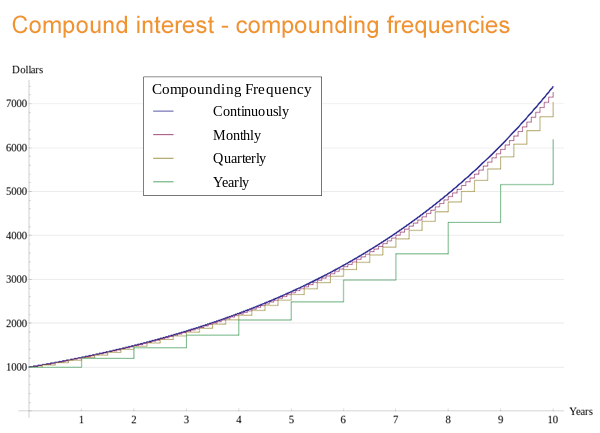
The second benefits is DRIP allows you to grow your investment at exponential rate by compounding. Then depending on the frequency of dividends payout you'll be compounding either monthly, quarterly or annually. Most people heard of compound interest and also learned it in school. This is the same thing, instead you are compounding your dividends. Below is a graph that shows the benefits of compounding and the different frequency of compounding.


Here is a quick calculator I found that helps you calculate the return on compound dividends. Calculator. Start investing and start DRIPing, let the power of compound work for you.

1/02/2018

Neighbour Joe - January 2018 Net Worth

Happy New Year. Although this month is the beginning of a new calendar year it is not the end of the fiscal year therefore I won't be doing a year end summary till April.

As we entered into 2018, the first thing I did was make a lump sum payment into my mortgage with money that I have set aside. Here is my net worth as of today and the current breakdown.

Asset
Chequing: 433.41
TFSA Investment: $57,333.46
TFSA Mutual Fund: $3,840.08 (Invested in TD e-series index fund)
Real Estate: $224,000 (Purchase Price of my house)
Define Benefit Work Pension (Current Transfer Value): ~$153,000 (Last checked in Jul 2017,aprox $1000 a month of contribution)

*Automobile is not included (No monthly car payment)

Liabilities
Mortgage: $135,126.07

*Credit Card is paid in full every month

December Net Worth: $300,758.74 
Current Net Worth $303,480.88 (+0.9%)

Like a few net worth updates in 2017, the reason for my increase this months beside my usual salary income is from my investment portfolio. I re-consolidated all my marijuana investment and put it all into Canopy Growth (TSX: WEED). In the the last two weeks of 2017 the stock price jumped 48% giving me a unrealized gain of $3,540. I sold some of my holdings and realized about $350 gain on the last trading day of 2017. Hope all of you had a good holiday season and may all your financial goal be met in 2018.

12/24/2017

Thrifty Salaryman - December 2017 Net Worth Update

Since October and November, the market improved even more with the traditional Santa Claus rally in December. I’ve also increased my RSP e-Series index fund to a total of about $21K to take advantage of its lower management fee. My liability remained similar as my last update in November as a result of the holiday shopping season. Because of that, my next contribution to my investment probably will need to wait until I pay my credit card bill in mid-January. Everything is still within the interest-free grace period.

My current net worth is now $55,833.27, an increase of 11% from my November update of $50,227.24.


Cash $5,770.37

Investment $55,536.26:
$23,575.00 - Equity (Corporate Stock) - TD Direct Investing TFSA
$6,184.75 - Canadian Index Fund - RBC TFSA Mutual Fund Account - MER 0.72%
$21,193.45 - Canadian Bond Fund - TD e-Series RSP Mutual Fund Account - MER 0.50%
$3,078.80 - US Equity Index Fund - Employer Pension Plan - MER 0.15% + $55 account fee
$1,504.26 - Canada Equity Index Fund - Employer RRSP - MER 0.15%


Liability:
$5,473.38 - Credit Card Balance (Still within grace period)

12/22/2017

Canadian Median Family Net Worth - $295.1K

If you haven't notice, I spend a lot of my off time reading the news. Mostly CBC and Financial Post, it's a good way to stay updated on current events and market trends. I've recently read an article on CBC that talks about the median net worth of Canadian family in 2016. I figure I'll share this article, since we are using net worth as our main indicator of wealth.

Here is the Article

Bottom line, the median net worth for a Canadian Family is $295.1K. My latest net worth updates in December was $300,758.74. I am above the median, Awesome! If you are starting your own journey then hopefully this article will give you a quick benchmark to strive for. Happy Holiday!

12/16/2017

Neighbor Joe - Passive Income Update

Back in October, I posted my passive income breakdown as another method to track my wealth building progress.October Passive Income. Here is the updated spreadsheet, so now instead of receiving $1024/year I have increased my passive income to $1463/year.


In the past few months, I invested more into Enbridge since they were trading at a price that yields about a 5% return for dividends. I also did some rebalancing of my portfolio, I sold some of my Shopify Shares and invested into MasterCard. Next year I am going to try and double my passive income. Come back and check often to see how I go about doing it.

12/08/2017

Books for new investor #2

A few months ago I wrote a post about books that I found beneficial for new and young investor like myself. Here is the link to that post. In it, I talked about three books that I have read which gave me some good insight on how to start building wealth. There is also a compiled list on the left-hand side under popular post.

Today I am going to talk about two new books that I have recently finished in which I found beneficial to my learning.
 

The Millionaire Next Door & The Millionaire Mind The first two book that I am going to discuss are written by a professor named Dr. Stanley. Dr. Stanley did a series of survey on people with net worth of over $1M in the early 90's and he observes that a lot of them possess similar character traits. If you only have time to read one book then just read the first one "The Millionaire Next Door". The second book is just an extension to the topic discussed in the first one.
What I want to share from the book was how wealthy people spend their money. Basically, the book said that most of the time you would not know someone is a millionaire base on the clothes, car or other materials they own. It basically means that they stereotypical wealthy personality you see on TV is not how real-life millionaire behaves. Most wealthy people work hard for their money so they are very mindful when spending it. If you don't believe me, just watch some video about Warren Buffet, Bill Gate, Mark Zuckerberg and Jeff Bezos, all these people drive relatively humble cars compared to their net worth. Bottom line is, if a person looks rich then they are most likely not that rich.
On the topics of cars, Dr. Stanley did a study and found that most millionaires own relatively cheap cars. Also, most of them don't really go shopping for a new car every few years unless needed. Key word in the last sentence is "needed", don't confuse that with "want", "desire" or other similar words. In his study, he even compares the more wealthy to the less wealthy and found that the less wealthy spend more money and shop more often for cars.
A story from the book about why wealthy people don't like spending much on cars is as follow. There was a CEO of a company that was well liked by his employee so they all got together to buy him an expensive car. His employee all thought that he will appreciate a luxury car since his current car is considered a poor man's car. This CEO appreciated the gesture but did not really like the car. His reasoning was that he really enjoys fishing and with such a luxury car he won't be able to go fishing with it. He'll also have to spend more money on maintenance and gas for this expensive car. What Dr. Stanley was trying to highlight from this story was the secondary and tertiary spending associated with an expensive item.
I'll use a similar example to explain my point, let say you just bought a brand new townhouse in Toronto for $500,000. Will you now go buy cheap $200 futon or a $2000 couch? Do you buy second-hand appliance or brand new appliance? It has been known in behavioral economics that consumer spends in relative term instead of absolute value. That means that people usually have a figure in mind for their budget relative to the purchase price of their house. So in this case, the fact that you spend $500,000 on a house means you will naturally spend more on appliance and furniture. Then now you'll need nice dish and cups to go with the new appliance and so on. Now your original spending of $500,000 has become much more then you anticipated. Most millionaires understand this concept and try to avoid the root causes of spending, which in this case is to spend less on a house.

Another interesting concept he discussed in his book was something called "income statement affluent" which is the opposite of another term he used, the "balance sheet affluent". The basic idea is that the income statement affluent are people that have a high income but save very little where the balance sheet affluent are very good savers. His argument was that income has very little influence if someone becomes wealthy or not. For someone to become wealthy you need to be good an offense(earnings) and defense(savings). Which means even if you earn a lot but you spend just as much then you'll never become truly wealthy because one day you'll stop earning.